NEXTcampusAI — AI University Admissions Platform
Live product · nextcampusai.com
A live, in-use AI product I conceived, scoped, and shipped: NEXTcampusAI matches applicant profiles to German master's programs, flags eligibility gaps before they become rejections, and tracks a multi-university, multi-portal application pipeline in one place. Real users today — nextcampusai.com.
Overview
Live product — nextcampusai.com
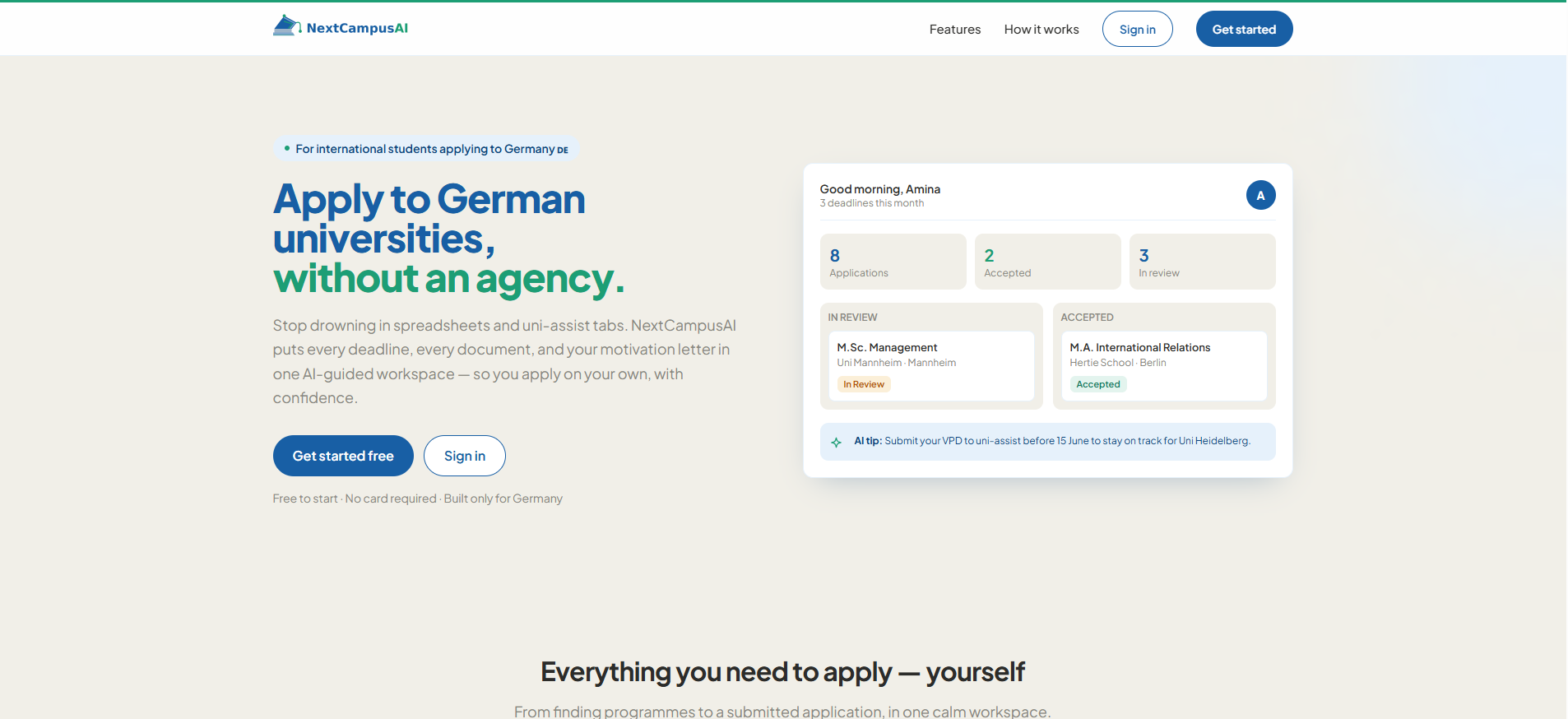
NEXTcampusAI is a working, live product I built to solve a problem I lived through myself: applying to European (primarily German) master's programs is a fragmented, high-friction process spread across a dozen different university portals, each with its own eligibility rules, grade-conversion quirks, and document requirements. NEXTcampusAI is an AI-driven platform that matches applicant profiles to suitable university programs, flags eligibility gaps before they become rejections, and helps manage the resulting multi-university, multi-portal application pipeline.
Challenge
International university applications — especially into the German system — have a specific set of hard, recurring problems:
- Grade conversion is opaque and inconsistent — a Bangladeshi (or other international) CGPA has to be converted to the German scale (commonly the modified Bavarian formula), and getting it wrong means applying to programs you don't qualify for, or missing ones you do
- Eligibility rules vary by program, not just by university — the same applicant can clear one program's cutoff and fail another's at the same institution
- Every portal is different — uni-assist, individual university portals, and program-specific systems each have their own submission process, document-format expectations, and status-tracking mechanisms
- Applicants juggle many parallel applications with different deadlines, document sets, and decision timelines, with no single place to track it all
Approach
AI matching advisor
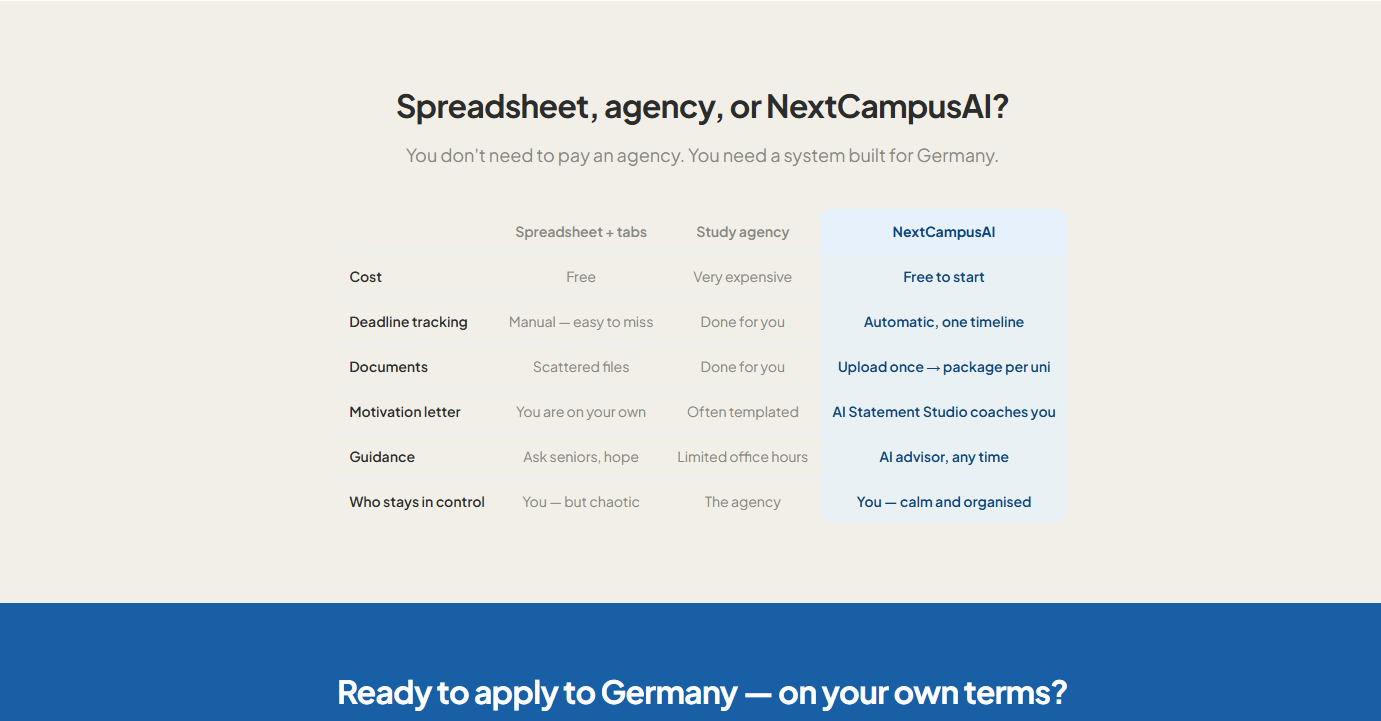
An advisor that takes an applicant's profile (grades, test scores, credit/ECTS systems) and matches it against suitable university programs — explicitly flagging eligibility gaps rather than leaving applicants to discover a rejection reason after the fact.
Multi-portal application tracking
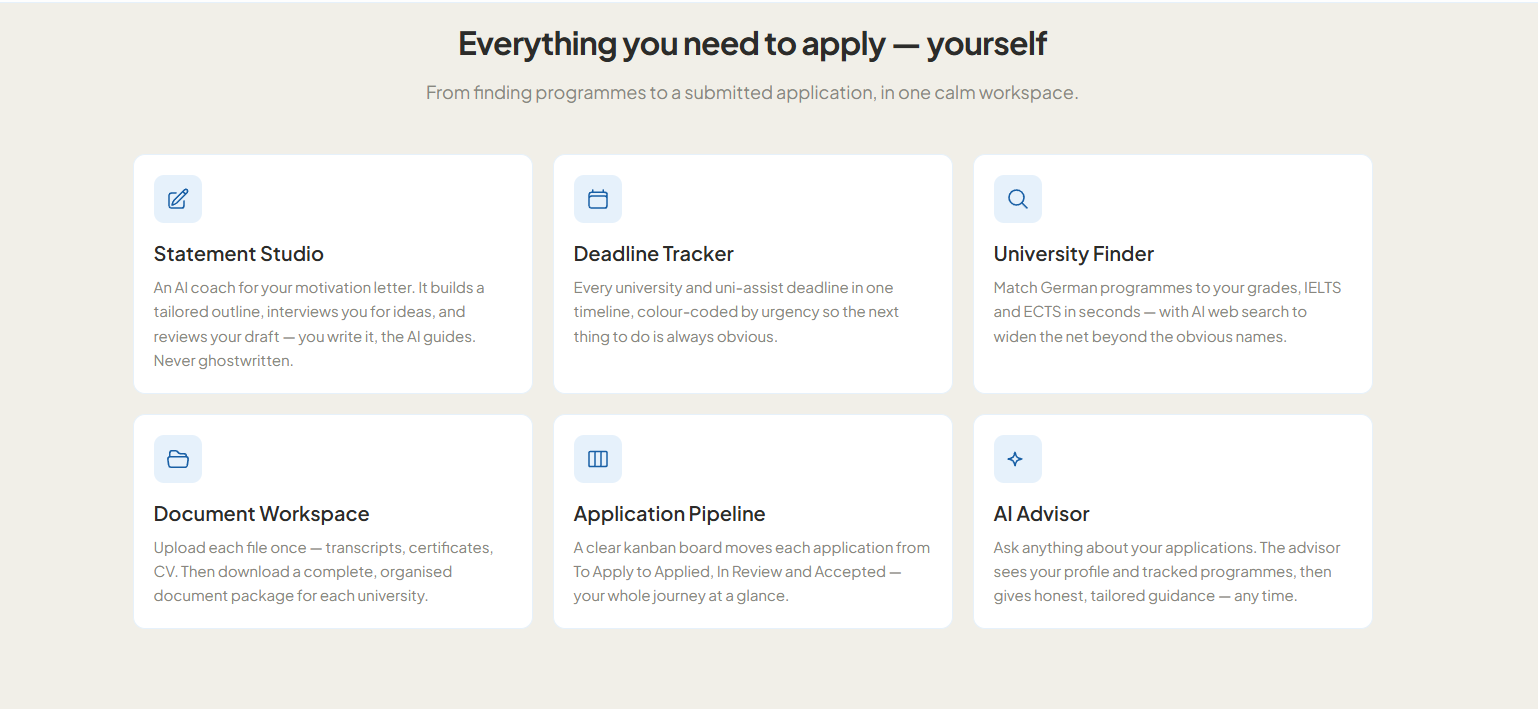
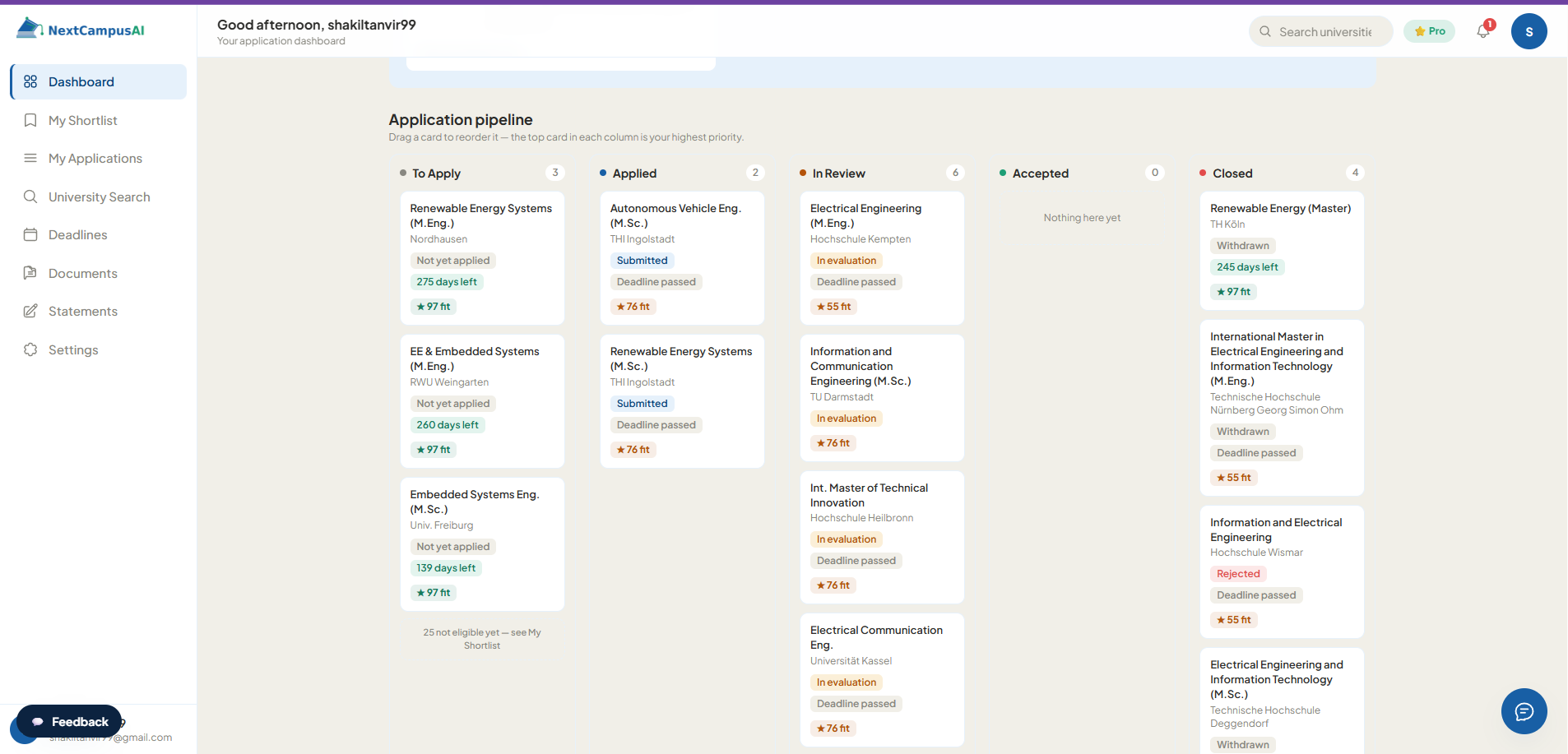
A workflow to search, shortlist, and manage applications across multiple universities and multiple application portals in one place, rather than requiring the applicant to independently track each one.
Conversational advisory flows
AI-guided conversations that walk applicants through document requirements, deadlines, and program-fit decisions — turning a research-heavy process into a guided one.
Live, in-use product
NEXTcampusAI is live and has real users today, not a prototype. It's an active product I continue to develop, treating specification as a distinct phase from implementation — the current tracker-tool specification, for instance, was fully scoped before any implementation work began.
Results
Why it matters (industry)
This project demonstrates something a pure embedded-firmware portfolio doesn't: the ability to conceive, scope, build, and ship a live product with real users — not a proof of concept. It shows product thinking (identifying a genuine friction point), technical range (AI/ML-driven matching logic, not just embedded C), and the same disciplined specification-before-implementation approach that shows up in my systems-architecture work. For any team evaluating me for AI-adjacent or product-facing engineering roles, this is direct evidence I can carry a product from idea to production.
Why it matters (academic / technical depth)
NEXTcampusAI is also a personally-motivated research problem: modelling cross-institutional academic equivalence (grade conversion, ECTS/credit-system mapping, program-specific eligibility logic) is a genuinely nontrivial matching problem — closer to constraint satisfaction than simple filtering. Having gone through the exact process the platform automates — navigating uni-assist, multiple German portals, and grade-conversion disputes — gives this project a grounded, first-hand accuracy that a generic ed-tech tool wouldn't have.

192 views